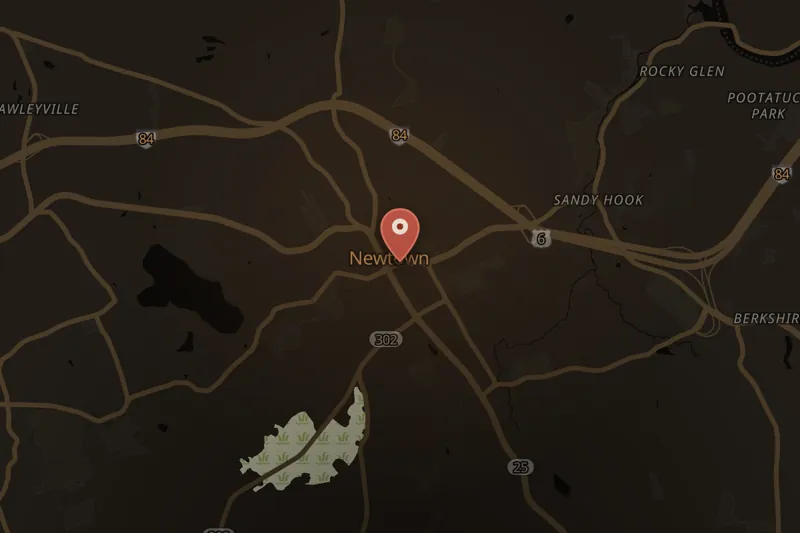
On July 22, 1886, in the rural village of Morris, Litchfield County, Connecticut, 16-year-old Mattie Randall — a schoolteacher and, according to the Hartford Courant, "the belle of the village" — was found shot dead on her father's farm. She had reportedly rejected the advances of her father's farmhand, Charles Lockwood, a 35-year-old man with a history of jail and prison time, after which she became engaged to another man. Lockwood had allegedly lured her to an isolated field under the pretense of farm work and shot her with a shotgun before fleeing into the woods, leaving his hat and gun behind. There were no eyewitnesses to the killing, and her father and brother discovered her body that afternoon.
News of the murder triggered an enormous manhunt. Hundreds and eventually as many as fifteen hundred men from surrounding towns including Torrington, Litchfield, Thomaston, and Watertown converged on the area, forming armed posses under Sheriff Champlain that blocked roads and searched the countryside for three days and two nights. Contemporary accounts describe the searchers as heavily armed, sleep-deprived, and drinking hard cider, with local judge Huntington reportedly voicing concern that Lockwood might be shot on sight and warning against lynching in Connecticut.
On Sunday, July 25, 1886, two boys found Lockwood's body hanging by a rope from a chestnut tree near the Randall farm, in an area the search had already passed through. Estimates of the time of death varied: the medical examiner suggested around midnight, roughly twelve hours before discovery, while some accounts claimed the body was still warm. A mob of roughly three hundred armed men rushed toward the body, and guards reportedly had difficulty preventing them from mutilating it. Lockwood's body showed non-lethal injuries, including a burn and scorched clothing on his chest consistent with a gunshot, and a cut throat, which newspapers speculated could reflect suicide attempts or an accidental discharge. He had allegedly stolen the rope used in the hanging, though its theft was not reported until after the body was found.
A coroner's jury convened by J. B. Hardenburgh on July 27, 1886, ruled Lockwood's death a suicide. Public opinion split along regional lines, with Boston and New York papers favoring the lynching theory and Connecticut papers favoring suicide. In January 1887, the Chicago Tribune listed Lockwood among 1886 lynching victims. Sociologist James Elbert Cutler, writing in 1904, argued the evidence favored the lynching theory. A Michigan newspaper, the True Northerner, published an account claiming Lockwood had been tortured and stabbed before being hanged. In 1928, the Hartford Courant published an essay arguing Lockwood died by suicide and that Connecticut should remain on a list of states without lynchings. If Lockwood's death is classified as a lynching, he may be the only known lynching victim in Connecticut and New England history, notable also because he was white.


 COLDListen