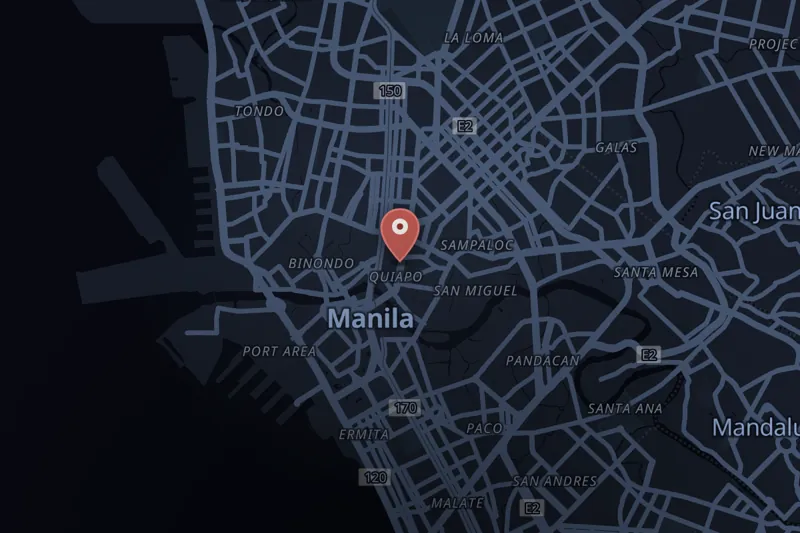
On August 21, 1971, a Liberal Party campaign rally at Plaza Miranda in the Quiapo district of Manila was attacked when two grenades were reportedly thrown onto the stage. The rally, attended by roughly 4,000 people, had been convened to proclaim the party's senatorial candidates and its candidate for Manila mayor. Manila Liberal Party chairman Salvador Mariño, serving as emcee, had just begun speaking when the explosions occurred.
Nine people were killed, including a five-year-old child and Manila Times photographer Ben Roxas. Ninety-five others were injured. Nearly everyone on the stage was hurt, among them Representatives Ramon V. Mitra Jr. and Salipada Pendatun, Senators Jovito Salonga, Eva Estrada-Kalaw, and Gerardo Roxas (also Liberal Party president), Judy Araneta-Roxas, former Representative Eddie Ilarde, former Cebu City mayor Sergio Osmeña Jr., Governor Felicisimo San Luis, Manila Councilors Martin B. Isidro and Ambrosio "King" Lorenzo Jr., and Congressman Ramon Bagatsing, the party's mayoral candidate. Salonga was among the most seriously hurt, left blind in one eye and deaf in one ear, with shrapnel remaining in his body until his death in 2016. Lorenzo spent two weeks in a coma and lost sight and hearing on one side. Bagatsing lost his left leg and suffered a crushed cheekbone and shattered arm.
Responsibility for the bombing has never been legally established and remains disputed. President Ferdinand Marcos publicly blamed communists and used the attack to justify suspending the writ of habeas corpus, a move later regarded as a precursor to his 1972 declaration of martial law. Manila Mayor Antonio Villegas was initially named a primary police suspect, though later evidence pointed away from him. Suspicion also fell on Marcos himself, amid a wider series of deadly 1971 bombings; reporting has noted CIA assessments privately attributing at least one such bombing to Marcos and expressing near-certainty that communists were not behind the blasts, along with a later-established false-flag attack involving Defense Minister Juan Ponce Enrile in 1972.
Others, including Salonga in his own memoir, attributed the bombing to the Communist Party of the Philippines (CPP) under Jose Maria Sison. Former military officer Victor Corpus, a one-time New People's Army member, alleged Sison ordered the attack. Unnamed former CPP officials, quoted by The Washington Post, alleged that party leadership planned the bombing to provoke government repression and drive recruitment. Sison has denied these allegations, and the CPP has never claimed responsibility. Historian Joseph Scalice has argued the evidence points to CPP responsibility, a conclusion Sison disputes, criticizing Scalice's reliance on military-intelligence-linked sources.
Politically, the bombing contributed to the radicalization of moderate opposition figures and to Liberal Party gains in the 1971 elections, including Bagatsing's defeat of incumbent Villegas for Manila mayor. In 2002, President Gloria Macapagal Arroyo unveiled a commemorative marker at Plaza Miranda honoring the nine victims.

 Credit: Eugene Alvin Villar (seav)CC BY-SA 3.0SourceUNSOLVEDListen