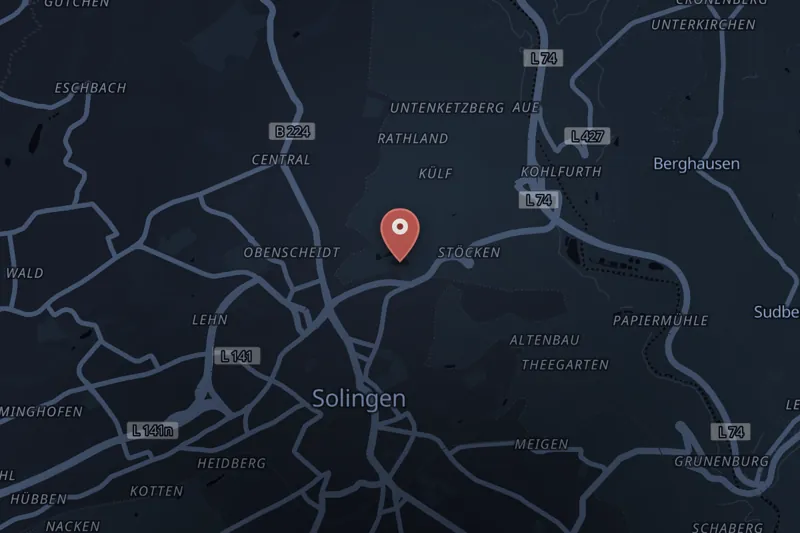
In the early hours of 29 May 1993, four young men with ties to the far-right skinhead scene in Solingen, North Rhine-Westphalia, set fire to the home of a Turkish family at Untere Wernerstraße 81. According to the police report, the fire — set with gasoline — broke out at the building's entrance at 1:38 a.m. Firefighters arrived within five minutes, but the blaze had already spread through the house. Five family members died: Gürsün İnce, 27, died after jumping from a window while holding her four-year-old daughter, who survived; the girls Hatice Genç, 18, Gülistan Öztürk, 12, Hülya Genç, 9, and Saime Genç, 4, died in the flames. Fourteen other family members were injured, some severely, including Bekir Genç, 15, who jumped from a burning window, and a six-month-old infant and a three-year-old child who suffered life-threatening injuries. Mevlüde Genç, then 50 and the family's oldest member, escaped through a window and alerted neighbors; she lost two daughters, two granddaughters, and a niece in the fire.
The attack occurred amid a wave of anti-foreigner violence in Germany following reunification, including a December 1988 arson in Schwandorf, the September 1991 riots in Hoyerswerda, the August 1992 riot in Rostock-Lichtenhagen, and a November 1992 arson in Mölln that killed three Turkish residents. Three days before the Solingen attack, the German Bundestag had voted to amend the constitution to restrict asylum rights. The Solingen fire, which killed five people, was described as the most severe instance of anti-foreigner violence in Germany up to that time. It was followed by protests among Turkish diaspora communities in several German cities and by large solidarity demonstrations among other Germans.
The four defendants — Felix Köhnen, 16; Christian Reher, 16; Christian Buchholz, 19; and Markus Gartmann, 23 — were members of Solingen's far-right skinhead scene who trained together at a martial arts school later revealed to have been run by an informant for North Rhine-Westphalia's domestic intelligence agency. Gartmann confessed to police and, separately, before a magistrate, and apologized to the victims, though he later withdrew the confession, saying it had been made under duress. Reher also confessed but changed his account repeatedly. Köhnen and Buchholz denied any involvement. Prosecutors cited hatred of foreigners as the motive. The trial opened in April 1994 before five judges of Düsseldorf's Higher Regional Court, with Köhnen, Reher, and Buchholz charged as minors and Gartmann charged as an adult.
In October 1995, all four defendants were found guilty of murder, attempted murder, and arson. Köhnen, Reher, and Buchholz received the maximum juvenile sentence of 10 years; Gartmann was sentenced to 15 years. The Federal Court of Justice of Germany upheld the convictions on appeal in 1997. The family separately sued for civil damages and was awarded approximately 270,000 German marks, along with a monthly pension for one severely burned victim.
Memorial services drew senior German officials, including President Richard von Weizsäcker; Chancellor Helmut Kohl did not attend. A memorial was unveiled a year after the attack near the school Hatice Genç had attended. In 1996, the German government awarded Mevlüde Genç the Bundesverdienstkreuz (Federal Cross of Merit) in recognition of her subsequent advocacy for understanding between Turks and Germans, and in 2008 Germany established the Genç Prize in her name to honor similar work. In September 2005, Reher was sentenced to four months in prison for using the Hitler salute on two occasions.


 SOLVEDListen