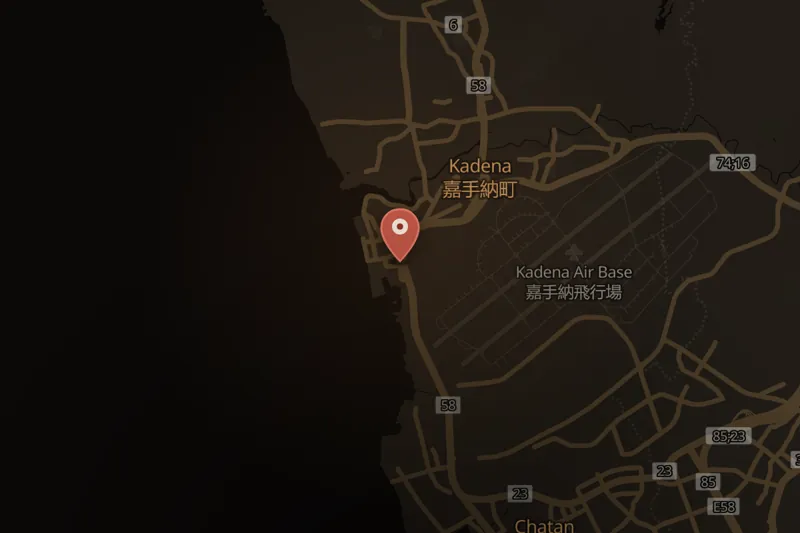
On 4 September 1955, the mutilated body of a young girl was discovered in a landfill belonging to Kadena Air Base in Kadena, Okinawa, then under the United States Civil Administration of the Ryukyu Islands. The victim, identified as five-year-old kindergarten student Yumiko Nagayama (sometimes reported as Yumiko Arakaki) of Ishikawa, had been reported missing after failing to return home from playing outdoors. Her body showed signs of rape and had reportedly been cut with a sharp knife from the abdominal region to the bowel.
A brown hair found on the body led investigators to suspect a foreign perpetrator, prompting a joint investigation by the U.S. military and the Ryukyu Police. Investigators determined that Nagayama had likely been abducted at an Eisa performance, where witnesses reported seeing her leave with a white man, pointing to a U.S. serviceman. An indictment followed against Sergeant Isaac J. Hurt of B Battalion, 32nd Artillery Division, on charges of murder, rape, and kidnapping. Hurt, born in Lothair, Kentucky, had previously served 11 months in jail in Michigan for assault and attempted rape.
The case provoked outrage among Okinawans, compounded by the fact that under extraterritoriality arrangements Hurt would face an American military court rather than an Okinawan court. A Rally for Protection of Children was held, and the Association for Protection of Children was formed in response. Okinawans demanded harsh punishment regardless of the offender's nationality and called for a public, civilian trial, but these requests were declined.
Hurt was court-martialed roughly two weeks after another U.S. serviceman, Raymond Elton Parker, was sentenced to life imprisonment for raping a 7-year-old Okinawan girl. Hurt's court-martial lasted 13 days; he maintained his innocence but was convicted after less than an hour of jury deliberation and sentenced to death. He was returned to the United States without Okinawan authorities being informed, a standard but controversial procedure. Following sentencing, hometown supporters and several U.S. politicians, including a Representative and two Senators, sought clemency or review, citing doubts about the evidence. In May 1959, the U.S. Army Secretary reviewed the case and affirmed Hurt's guilt, citing his prior convictions and a 1942 falsification of enlistment records. Nonetheless, in 1960 President Dwight D. Eisenhower commuted the sentence to 45 years without parole.
Hurt was later transferred to the U.S. Penitentiary in Leavenworth, Kansas, suffered a stroke in 1969, and repeatedly sought parole. In January 1977, President Gerald Ford made Hurt and five other former military death-row inmates eligible for parole; Hurt was released later that year, subsequently working as a night watchman and marrying in 1981. He died in 1984 at a Department of Veterans Affairs hospital in Ohio. In 2021, Okinawa Times reported on his release and the VA-provided military headstone on his grave, prompting renewed criticism from Okinawan peace activists.
The case is credited with catalyzing the first major coordinated anti-U.S. military protests in occupied Okinawa.


 Credit: U.S. MilitaryPublic domainSourceUNSOLVEDListen