Active case
Deal barracks bombing
Documents violence · ongoing investigation — written to inform, not to shock.

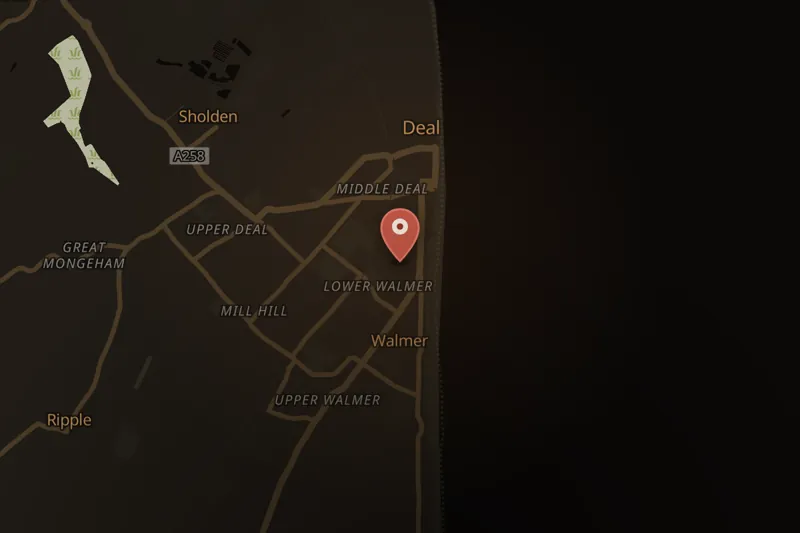
At 8:22am on 22 September 1989, a 15-pound (6.8 kg) time bomb exploded in the recreational centre changing room at the Royal Marines School of Music, part of the Royal Marine Depot in Deal, Kent. The blast destroyed the recreational centre, levelled the adjacent three-storey accommodation building, and caused extensive damage to the rest of the base and nearby civilian homes. The explosion was heard several kilometres away and produced a large pall of smoke over the town of Deal.
Most of the personnel who used the building as a barracks had already risen and were on the parade ground practising marching when the blast occurred; they witnessed the buildings collapse. Some marines remained inside the building and received the full force of the explosion. Many were trapped in the rubble for hours, requiring military heavy lifting equipment to clear. Kent Ambulance Service voluntarily suspended industrial strike action to assist the wounded. Ten marines died at the scene, with one body later found on the roof of a nearby house. A further 21 were seriously injured and treated at hospitals in Dover, Deal and Canterbury. One of the injured, 21-year-old Christopher Nolan, died of his injuries on 18 October 1989, bringing the total death toll to 11. Three of those killed were buried nearby at Hamilton Road Cemetery in Deal.
The Provisional IRA claimed responsibility, describing the attack as a continuation of its campaign against British troops in Northern Ireland since 1969. The attack drew strong public and political reaction because it targeted a ceremonial military band whose training was largely oriented toward saving lives, and because many of the dead and injured were teenaged new recruits. Prime Minister Margaret Thatcher, then on an official visit to Moscow, said she was "shocked and extremely sad." Opposition leader Neil Kinnock called it an "awful atrocity." Commandant General Royal Marines Lieutenant-General Sir Martin Garrod condemned those responsible on television shortly after the bombing.
The base's security arrangements, which had partly relied on a private security firm, became controversial and prompted a review of security procedures across British military bases; the firm's employees at Deal were subsequently replaced with Royal Marine guards. One week after the bombing, staff and students of the School of Music marched through Deal, watched by thousands, maintaining gaps in the ranks to mark those who could not march due to death or serious injury. A memorial bandstand was later built at Walmer Green, and the site of the destroyed barracks chapel — itself lost in a 2003 fire — is now a memorial garden. The barracks were decommissioned in 1996 and converted into flats, and the School of Music relocated to Portsmouth. Annual memorial events continue at the Walmer Green bandstand, including a 30th-anniversary concert in 2019 attended by over 12,000 people. No one has ever been arrested or convicted in connection with the bombing.

Key facts
- Victims
- David "Mac" McMillan, Richard "Taff" Jones, Tim Reeves, Christopher Nolan, Mark Petch, Andy Cleatheroe, Bob Simmonds, Mick Ball, Dean Pavey, Richard Fice, Trevor Davis
- Date
- 1989
- Location
- Royal Marine Depot, Deal, Kent, England
- Case status
- unsolved
Case timeline
1930
Royal Marines School of Music originally created at Portsmouth.
1950
Royal Marines School of Music moves to Deal.
1989-09-22
A 15-pound IRA time bomb explodes at 8:22am at the Royal Marines School of Music, Deal, collapsing the recreational and accommodation buildings; 10 marines die at the scene and 21 are seriously injured.
1989-10-18
Christopher Nolan, 21, dies of injuries sustained in the bombing, bringing the death toll to 11.
1996
The Deal barracks are decommissioned and later converted into flats; the School of Music relocates to Portsmouth.
2003
A memorial in the Deal Barracks chapel is destroyed when the building burns down.
2009-07
A memorial concert and re-dedication ceremony is held at the Walmer Green bandstand.
2015-09-22
On the 26th anniversary of the bombing, Deal Parochial Church of England School holds a re-dedication service for a restored Globe and Laurel stone from the former barracks.
2019
A 30th-anniversary memorial concert at the Walmer Green bandstand draws over 12,000 spectators.
Best coverage
No approved coverage links are attached yet.
People
David "Mac" McMillan
VICTIMBand Corporal, aged 26, killed in the bombing
citation on file
Richard "Taff" Jones
VICTIMMusician, aged 27, killed in the bombing
citation on file
Tim Reeves
VICTIMMusician, aged 24, killed in the bombing
citation on file
Christopher Nolan
VICTIMMusician, aged 21, died of injuries on 18 October 1989
citation on file
Mark Petch
VICTIMMusician, aged 26, killed in the bombing
citation on file
Andy Cleatheroe
VICTIMMusician, aged 25, killed in the bombing
citation on file
Bob Simmonds
VICTIMMusician, aged 34, killed in the bombing
citation on file
Mick Ball
VICTIMMusician, aged 24, killed in the bombing
citation on file
Dean Pavey
VICTIMBand Corporal, aged 31, killed in the bombing
citation on file
Richard Fice
VICTIMMusician, aged 22, killed in the bombing
citation on file
Trevor Davis
VICTIMMusician, aged 39, killed in the bombing
citation on file
Places
Common questions
- What happened to the victim?
- On 22 September 1989, the Provisional IRA detonated a time bomb at the Royal Marines School of Music in Deal, England, collapsing the recreational and accommodation buildings and killing 11 Royal Marines Band Service musicians, with 21 more injured. No one has ever been arrested or convicted.
- Where did the bombing happen?
- Royal Marine Depot, Deal, Kent, England.
- What is the current status of the case?
- Status: unsolved.
Sources
- Deal barracks bombingwikipedia · Wikipedia · 2026-07-07
- Contemporaneous coverage — BBC Newsnews · BBC News · 2026-07-07
- Contemporaneous coverage — The Telegraphnews · The Telegraph · 2026-07-07