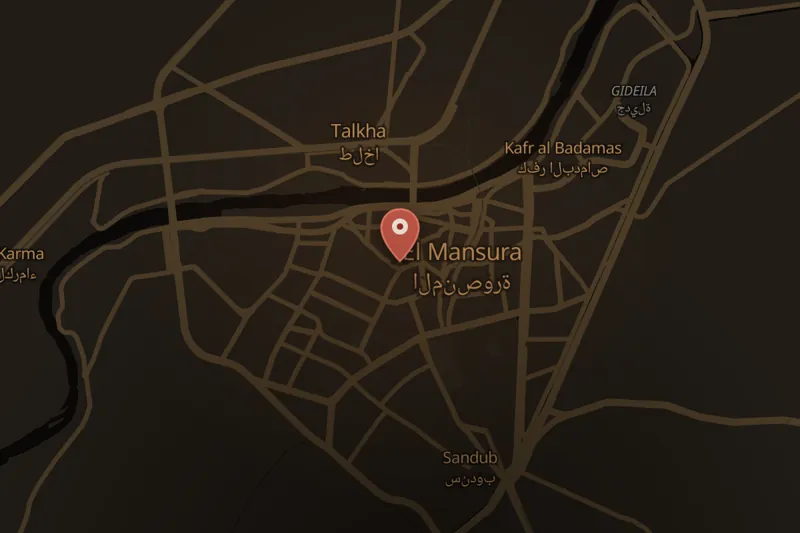
On the morning of Tuesday, 24 December 2013, an explosion struck the security directorate building in Mansoura, a city in Egypt's Nile Delta region. The blast partially collapsed the five-story building, killing at least 16 people — reported as 14 officers and conscripts and two civilians — and injuring more than 100 others. The Egyptian Ministry of Interior provided the casualty figures.
Details of the explosion's exact mechanics remained unclear in the immediate aftermath. A military statement indicated a car bomb was involved, while a security source from the Ministry of Interior described a truck carrying a large quantity of explosive material as the cause. Eyewitnesses told prosecutors they saw a truck drive into the compound's restricted parking area moments before the blast. Explosive experts had not conclusively determined whether the vehicle was remotely detonated or triggered by a timer, and officials did not rule out a suicide bombing after body parts were found inside an exploded vehicle near the site. Al-Ahram, citing an anonymous security source, reported that two bombs may have exploded simultaneously — one on an upper floor of the directorate and another in a car next to the building — with a third car bomb reportedly defused.
The attack caused extensive property damage, tearing apart walls of the directorate and damaging nearby structures including the city council, the National Theatre, and the United Bank. Port-Said Street, a major avenue near the building, was heavily damaged, with shop windows destroyed and the city theatre collapsing. Thousands of residents assisted with rescue operations, and many donated blood at area hospitals in response to official appeals.
No group immediately claimed responsibility. Prime Minister Hazem Al Beblawi, speaking for the interim government, quickly attributed the attack to the Muslim Brotherhood, formally labeling it a "terrorist organization" for the first time since the ouster of President Mohamed Morsi on 3 July 2013. Egyptian authorities also alleged that militants received logistical support from Hamas. Separately, Ansar Bait al-Maqdis, an Al-Qaeda-linked group active in the Sinai Peninsula, released an online statement claiming responsibility for the bombing and naming one of its own members as the perpetrator. Despite this claim, the Egyptian government maintained that the Muslim Brotherhood was behind the attack and intensified its crackdown on the organization.
Acting President Adly Mansour declared three days of national mourning following the bombing. Beblawi described the attack as the "most heinous form of terrorism" and vowed that those responsible would be brought to justice. The United States State Department condemned the attack in strong terms, while also expressing concern that Egypt's designation of the Muslim Brotherhood as a terrorist organization could undermine an inclusive political transition.
The bombing is widely regarded as a turning point in Egypt's post-2013 political landscape, followed by further violent clashes and bombings across the country.

 Credit: غير محددPublic domainSourceUNSOLVEDListen