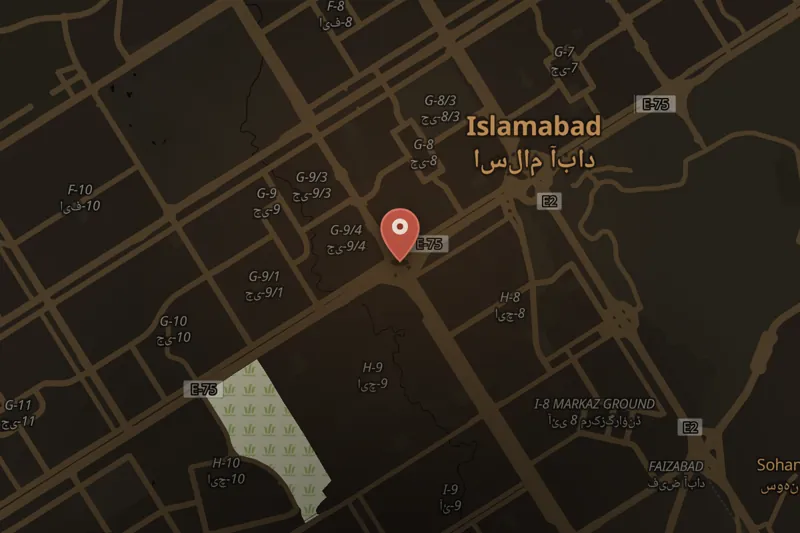
On the night of 20 September 2008, a dumper truck packed with explosives was detonated in front of the Marriott Hotel in Islamabad, Pakistan. The blast killed at least 54 people and injured at least 266, leaving a crater roughly 60 ft (18 m) wide and 20 ft (6.1 m) deep outside the hotel. The explosion was heard some 15 kilometres away and ruptured a natural gas line, sparking a fire that engulfed about two-thirds of the five-story, 258-room building. The attack occurred only hours after President Asif Ali Zardari delivered his first address to the Pakistani parliament.
Most victims were Pakistani citizens, but at least five foreign nationals were also killed, including the Czech ambassador to Pakistan, Dr. Ivo Žďárek, who died after returning to the burning hotel to assist in rescue efforts. Two American military personnel — a Navy cryptologist and a U.S. Air Force major — and a Danish intelligence agent were also among the dead, along with an Egyptian citizen. A U.S. State Department employee was reported missing and presumed dead. Approximately 40 hotel staff, including security guards who confronted the truck at the gate, were killed. According to the hotel's owner, Sadruddin Hashwani, guards had stopped the truck at the front barrier and exchanged fire with the driver before the bomb was detonated.
Investigators, including government advisor Rehman Malik, stated that the device used approximately 600 kg of RDX mixed with TNT-based explosives, mortar and ammunition, and aluminium powder to enhance its destructive power. Responsibility for the attack was disputed: a Taliban spokesperson denied involvement, an American intelligence official said the attack bore the hallmarks of an Al Qaeda-linked operation, some investigators suspected the group Harkat-ul-Jihad-al-Islami, and a group calling itself Fedayeen Islam claimed responsibility in a call to Al Arabiya television. U.S. officials later stated they believed Al Qaeda operative al-Kini had masterminded the bombing; he was killed in a U.S. drone strike on 1 January 2009.
In the investigation that followed, Pakistani police arrested three suspects — Mohammed Aqeel (also known, possibly, as Dr. Usman), Rana Ilyas and Hameed Afzal — in Peshawar on 17 October 2008, on suspicion of having facilitated the suicide bomber. They were held in custody for questioning by an anti-terrorism court. On 5 May 2010, Mohammed Aqeel, Rana Ilyas, Muhammad Hamid Afzal and a fourth individual, Tahseen Ullah, were acquitted of all charges, as no evidence was presented against them.
The Marriott reopened on 28 December 2008 following reconstruction arranged by owner Sadruddin Hashwani. An assistance fund for affected hotel employees and their families was established with contributions from Hashwani, Marriott International, and the J. Willard and Alice S. Marriott Foundation. In 2011, the family of an American victim filed a negligence lawsuit against Marriott in federal court in Maryland.



 UNSOLVEDListen