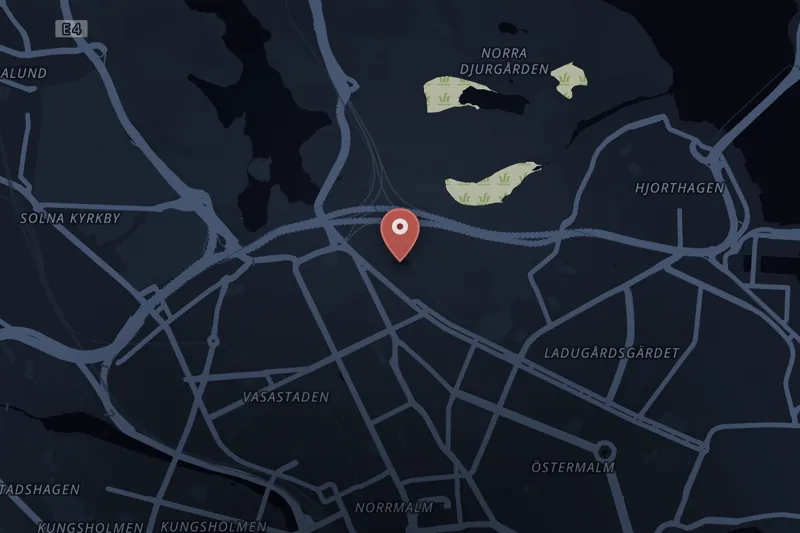
Between 3 August 1991 and 30 January 1992, a gunman shot eleven people in the Stockholm and Uppsala area, most of them immigrants; one victim died of his wounds and the rest survived, several with serious injuries. Swedish media called the attacker Lasermannen, or "the Laser Man," after the laser-sighted rifle he initially used. He was later identified as John Wolfgang Alexander Ausonius, born Wolfgang Alexander Zaugg on 12 July 1953 in Lidingö, the son of a Swiss father and a German mother. Bullied as a child over his non-Swedish appearance, he later bleached his hair and legally changed his name to John Stannerman, then John Ausonius. He worked as a taxi driver, then a stock and bond trader; poor investments and a gambling habit left him short of money, and he carried out more than eighteen robberies to maintain his lifestyle.
Ausonius had served in the Swedish army in 1981–82 and modified his own weapons, sawing down a rifle's barrel and stock and fitting a Smith & Wesson revolver with a silencer, amateurish work that caused him to miss several targets. His victims included David Gebremariam, a 21-year-old Eritrean immigrant shot in the back on 3 August 1991; Shahram Khosravi, a 25-year-old Iranian-born student shot in the face outside Stockholm University on 21 October 1991; Dimitrios Karamalegos, a homeless man of Greek origin shot twice in the stomach on 27 October 1991; and Heberson Vieira Da Costa, a Brazilian musician shot in the head and stomach in a Stockholm restaurant kitchen on 1 November 1991, who described his attacker to police. On 8 November 1991, Ausonius shot Jimmy Ranjbar, an Iranian-born student, who died of his wounds the next day — the spree's only fatality. After a trip to the United States, he resumed shooting in January 1992: wounding Erik Bongcam-Rudloff in Uppsala on 22 January; shooting Charles Dhlakama, a Zimbabwean bus driver, and two unnamed men at a Somali club on 23 January; shooting Isa Aybar, an Assyrian immigrant, four times in the head and arm on 28 January; and shooting Hasan Zatara, a Palestinian store owner, in the head on 30 January, leaving him paralyzed.
Police mounted a manhunt described as second only to the search for Olof Palme's killer, and Ausonius was arrested on 12 June 1992 during a bank robbery. At trial he assaulted his own lawyer and spent the rest of the proceedings in handcuffs; he was convicted of murder and robbery, though not formally linked to all of the shootings, and was sentenced to life imprisonment in January 1994. He confessed to the remaining attacks in 2000. He was held at Kumla Prison, transferred to Österåker Prison in June 2012. The National Board of Forensic Medicine found a repeated risk he would reoffend due to autism and a personality disorder, and courts rejected his bids to commute the sentence to a fixed term in 2008, 2010, and again on 2 November 2012.
In 2016 Ausonius was extradited to Germany to stand trial for the 23 February 1992 murder in Frankfurt of Blanka Zmigrod, a 68-year-old Holocaust survivor; prosecutors said he killed her and took her handbag, believing she had taken a device that held his bank account numbers. A German court convicted him and sentenced him to life imprisonment on 21 February 2018; after the Federal Court of Justice upheld the verdict, he was extradited back to Sweden in January 2019 to serve his sentences. A 2002 book about the case by journalist Gellert Tamas became a bestseller and was adapted into a play and a Swedish television miniseries.