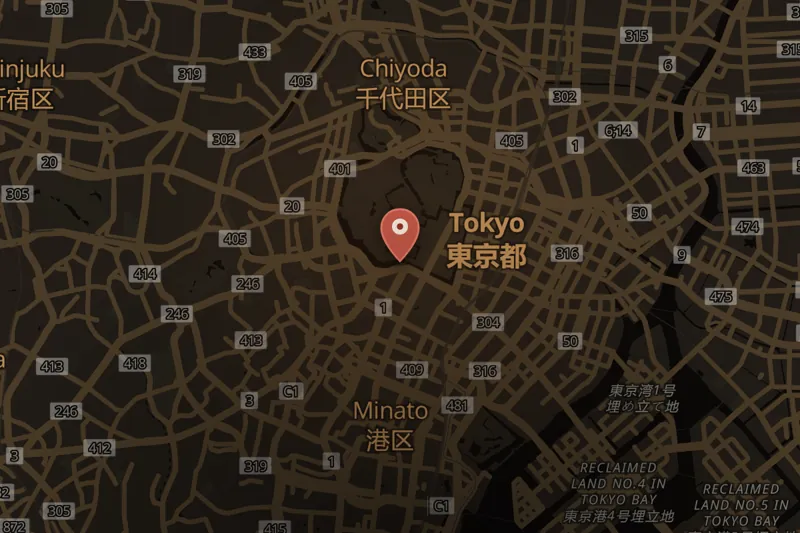
On July 6, 1957, at around 3:00 a.m., a fire destroyed the five-storied pagoda standing in Yanaka Cemetery in Taitō, Tokyo. The pagoda, originally part of the Buddhist temple Tennō-ji, had a long history: it was first built in 1644, burned down in 1771, and was rebuilt in 1791 using Japanese zelkova wood. At nearly 35 meters, this rebuilt structure was the tallest pagoda of its kind in the Kantō region. In 1908 it was donated by Tennō-ji to the city of Tokyo and later became famous as the model for Kōda Rohan's novel *The Five-Storied Pagoda*. By the time of the fire, it was a well-known city landmark and a symbol of Yanaka Cemetery.
After the blaze, two badly burned bodies — one male and one female — were discovered near the pagoda's middle pillar among the ruins. The remains were too severely burned to allow positive identification through direct examination. However, investigators found a thimble in the wreckage that helped establish, to a near-certainty, the identities of the deceased.
According to witness testimony, a woman in her twenties who worked as a seamstress at a Tokyo sewing shop, and a middle-aged man who was married, had both gone missing around the time of the fire. Witnesses stated that the two had been carrying on an adulterous relationship and had expressed a wish to burn themselves to death as an act of atonement. Based on this testimony and the physical evidence recovered at the scene, authorities and observers concluded that the two bodies found in the pagoda's remains were very likely those of the missing seamstress and her lover.
The destruction of the pagoda, a valued cultural asset, drew widespread and severe public criticism. Following the fire, a decision was made not to rebuild the structure; only the five original foundation stones were preserved at the site. The pagoda remained absent from the cemetery's landscape for decades.
In 2007, researchers at the Tokyo University of the Arts reported finding blueprints of the pagoda dated to 1970, spurring a movement to consider reconstruction. The estimated cost of rebuilding was placed at nearly one billion yen. The reconstruction proposal was approved by Hirayama Kunio.
No criminal charges are documented in connection with this case, as the two individuals believed to be responsible for setting the fire died in the blaze itself. The identities of the deceased were never confirmed with full certainty due to the condition of the remains, and their names are not established in the available record.


 Credit: Rs1421CC BY-SA 3.0SourceSOLVEDListen