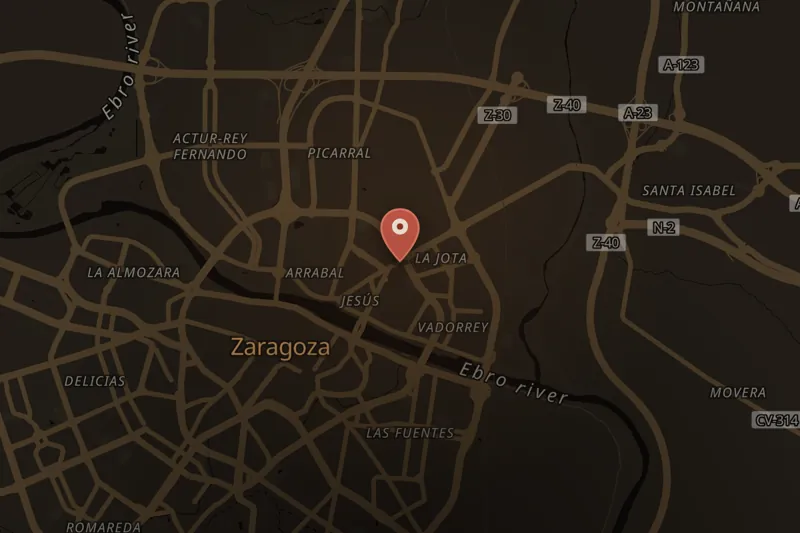
On 11 December 1987, a car bomb destroyed a Guardia Civil barracks on Avenida de Cataluña in Zaragoza, Aragon, Spain. The Basque separatist organisation ETA carried out the attack, using a vehicle packed with 250 kilograms of ammonal parked beside the four-storey building, which housed 40 families, about 180 people in total. The explosion killed 11 people, including five children, and injured 88 others, most of them civilians.
The bombing came almost six months after ETA's car bomb at the Hipercor shopping centre in Barcelona, which killed 21 people and injured 45. On 5 November 1987, the main Spanish political parties signed the Pact of Madrid, ruling out negotiations with ETA until the group formally disarmed. The Zaragoza attack was interpreted as ETA's response to that pact, and it occurred while the group was led by the Artapalo collective.
At 06:10, a Guardia Civil officer at the entrance saw two men parking a Renault 18 in front of the building. When he approached to tell them parking was not permitted, they fled in another vehicle waiting nearby. Before he could wake those sleeping inside, the ammonal detonated, collapsing all four floors and damaging neighbouring houses. A motorcyclist was accidentally killed by a military vehicle amid the emergency response. Rescuers worked through the night, and the last bodies, those of Angel Alcaraz and Maria Dolores Franco, were recovered at 13:45 the following day. The dead included three-year-old twins and girls aged six and seven.
The funerals of the 11 victims were held on 12 December 1987 at the Basilica of Our Lady of the Pillar. On 13 December, about 250,000 people demonstrated in Zaragoza under the banner "Zaragoza for peace and against terrorism." A memorial garden, the Park of Hope, was later built on the site, and an annual commemoration has been held since 1987.
Responsibility was placed on the Comando Argala, an itinerant unit of French citizens formed in 1978 and disbanded by police in 1990. Investigators identified four French nationals, Henri Parot, his brother Jean Parot, Jacques Esnal and Frederic Haramboure, as the attackers, acting on orders from ETA's Artapalo leadership. Arrests followed in 1989, 1990 and 1992, with Henri Parot detained in Seville in April 1990 and the Artapalo leadership captured in Bidart, France, in March 1992. In later trials, Francisco Mujika Garmendia and Jose Maria Arregi Erostarbe were each sentenced to 2,354 years for the 11 murders and the injuries, and Henri Parot received 1,802 years for the Zaragoza attack. Jean Parot, Esnal and Haramboure were sentenced to life imprisonment in France in 1997. Jose Antonio Urruticoechea Bengoechea, alias Josu Ternera, who relayed the order to attack, was later charged again in Spain and arrested in France in May 2019.


 Credit: D4444n at en.wikipediaCC BY-SA 3.0SourceSOLVEDListen


